AI Automation
Supplier Invoice Extraction and Approval
Source-linked invoice fields, purchase orders and receipts support human review, with discrepancy routing, approval checks and recoverable accounting writes.
Explore the solutionSolution design
The invoice reaches review with its evidence
The invoice workflow links extracted fields to the source document, supplier, purchase order and receipt. Validation separates capture errors from commercial discrepancies that require a decision. Reviewers receive the supporting evidence and record corrections or approvals before the accounting write. Duplicate checks, limited permissions and recoverable failures preserve that decision history through processing.
A review record brings together the original document, extracted fields, purchase order and receipt information. Unreadable data and commercial discrepancies follow different queues. Approved records reach the accounting system with the corrections and decisions preserved.
- Extracted fields linked to the source document
- Different routes for capture errors and disputed charges
- Approved records protected against duplicate creation
- Business context
- A retailer processing supplier invoices, purchase orders and delivery records across several locations
- Core capability
- AI & Automation
The checks behind a typed invoice
Invoices arrive as email attachments, scans and portal downloads. Their layouts and reference formats differ. Before entering a record, staff identify the supplier, find the purchase order, check which location received the goods and decide whether a difference needs attention.
The workflow prepares those materials together. Extraction supplies candidate fields; matching brings in order and receipt records. Reviewers see the discrepancies and make the commercial decision. The distinction matters because a neatly extracted invoice can still contain a disputed charge or refer to goods that the business has not received.
A poor scan and a disputed charge need different people
Discovery samples the document formats and follows their handling through approval. It records required fields, matching rules and the reasons records return for correction. Missing purchase orders, partial deliveries, credit notes and repeat submissions are included as regular processing categories.
An unreadable reference needs a capture correction. A legible quantity that differs from the receipt needs a purchasing or receiving decision. These conditions get different queues and owners. The process also distinguishes a rule that can be applied automatically from a judgement that needs someone familiar with the supplier or transaction.
Solution scope
- Document samples and exception mapping
- Controlled file intake and field extraction
- Purchase-order and receipt matching
- Reviewer queues and approval interface
- Accounting integration and duplicate protection
- Document quality and correction reporting
The original remains attached to the record
Intake assigns the document a stable identifier and records its origin. Extraction produces candidate values and, where possible, the location of each value on the page. Normalization makes dates, quantities and references usable by downstream systems while retaining the original text for review.
Rules check required fields, arithmetic and known supplier information. Matching uses the relevant purchase order and receipt through limited integrations. Each stage records its result and version. The reviewer can trace a proposed value back to the document and see whether a flagged issue comes from extraction, matching or a business rule.
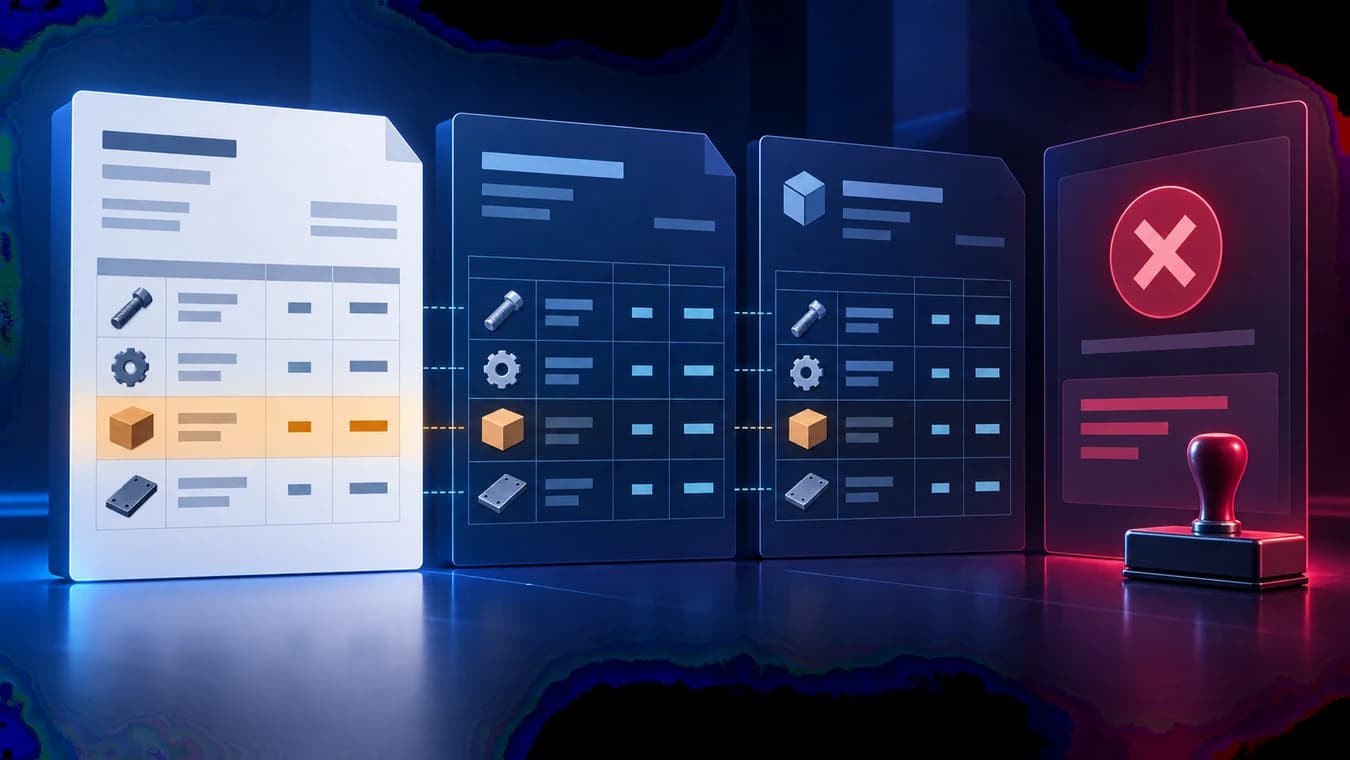
The mismatch beside the supporting documents
The workspace shows the invoice, extracted fields, order and receipt together. An unresolved check explains the discrepancy and identifies the information still needed. Corrections retain the original extraction and a record of who changed it, so later reviewers can follow the decision.
A missing delivery record goes to the receiving team; an unfamiliar supplier or disputed charge follows its own route. Requests for clarification stay attached to the case. Reviewers record the resolution and approval where required. The same record then supplies a quality signal about repeated document problems or extraction errors.
The operational flow
Receive the document
Record its source and store it through controlled file intake.
Prepare the fields
Extract candidate values and retain their document references.
Match the records
Check supplier details, arithmetic, orders and receipts.
Resolve flagged invoice discrepancies
Assign review to the person responsible for the particular issue.
Create the approved record
Write once through the accounting integration and preserve the decision history.
Readable information can still be wrong to process
Changed supplier details, unexpected bank information, disputed charges and quantity mismatches require the relevant review. The system compares against approved records and flags the condition. A model's confidence in its reading does not establish that the supplier request is valid or authorized.
Duplicate checks use several attributes and allow a reviewer to distinguish a corrected invoice from an accidental repeat. Credit notes and partial deliveries retain links to the original transaction. The approval records the responsible person and decision. Payment execution remains outside this extraction workflow; an approved accounting record does not itself instruct a payment.
Document content cannot alter processing permissions
Files pass through controlled intake, format checks and the agreed file-safety controls before extraction. Instructions written inside a document remain document content. They cannot change the workflow's permissions, approval requirements or rules for writing into the accounting system.
Review access follows responsibility, with sensitive supplier information excluded from broad monitoring views. Retention includes originals, extracted data, temporary copies and decision records. Integration permissions are limited to the required actions. A failed write leaves a visible recoverable case, with enough state to determine whether retrying would create a duplicate.
A reviewed sample before live processing
The first release is evaluated against human-reviewed documents covering the actual formats and exceptions. Checks include important field values, document classification, matching and queue assignment. Results are separated by document type and source quality so a familiar clean layout cannot hide failures on poor scans or another supplier's format.
The live pilot prepares records under existing approval requirements. Review covers correction effort, queue behaviour, accounting writes and the audit trail. A reduction in review steps requires a decision by the process owner for the relevant case type. New formats enter the reference set before they become routine processing work.
Some recurring errors start before extraction
Finance and purchasing own approval and commercial rules. Operations owns receipt information. Engineering maintains intake, extraction and integrations. A process owner follows issues across those responsibilities, including cases that repeatedly wait for information no single reviewer can supply.
Quality review separates extraction errors from incomplete supplier records and poor source documents. The right fix may be a parser adjustment, a clearer purchase-order requirement or a change to receiving practice. Routing and review-rule changes are documented and checked for their effect on workload, so the team can reverse a change that creates unexpected queues.
The approved record is the unit of completion
Evaluation covers important field accuracy, exception types, correction effort and downstream record creation. A document is followed through approval into the accounting system. The review checks that its source, corrections and decision remain traceable and that repeated processing does not create another record.
Queue analysis identifies where effort moves after extraction. Faster preparation can expose a receiving-data gap or concentrate work with a particular reviewer. That finding leads to an assigned process change. The useful comparison includes the entire processing task, with attention to the documents that still consume substantial human effort.
The choices behind the solution
Separate extraction and commercial review
Route unreadable fields differently from disputed quantities or charges.
Correcting a transcription does not require the same authority as accepting a commercial discrepancy.
Retain the source and corrections
Link each prepared record to the original document and its review history.
A later question needs a traceable explanation of what changed and why.
Approval before the accounting write
Write records only after the required checks and decisions are complete.
Accurate text extraction alone cannot establish that an invoice is ready to process.
How the solution is evaluated
These measures define the evaluation criteria for the workflow, its controls and the quality of completed tasks.
Important field accuracy
Measure: Compare extracted values with reviewed references by document type.
Success criteria: Critical information is correct or clearly assigned for correction.
Correction and exception effort
Measure: Review the human work needed from intake through approval.
Success criteria: Less transcription does not create hidden review work elsewhere.
Accounting-record integrity
Measure: Trace approved documents through writes, failed attempts and retries.
Success criteria: Each approved record is attributable and created without unintended duplication.
A prepared invoice should let the reviewer focus on the discrepancy, not search for the documents needed to understand it. Keeping the source, purchase order, receipt and decision together makes that possible. The same record gives finance a dependable explanation later, when a supplier asks about a correction or a transaction needs review.