Retail & E-commerce
Self-Service Order Tracking and Returns
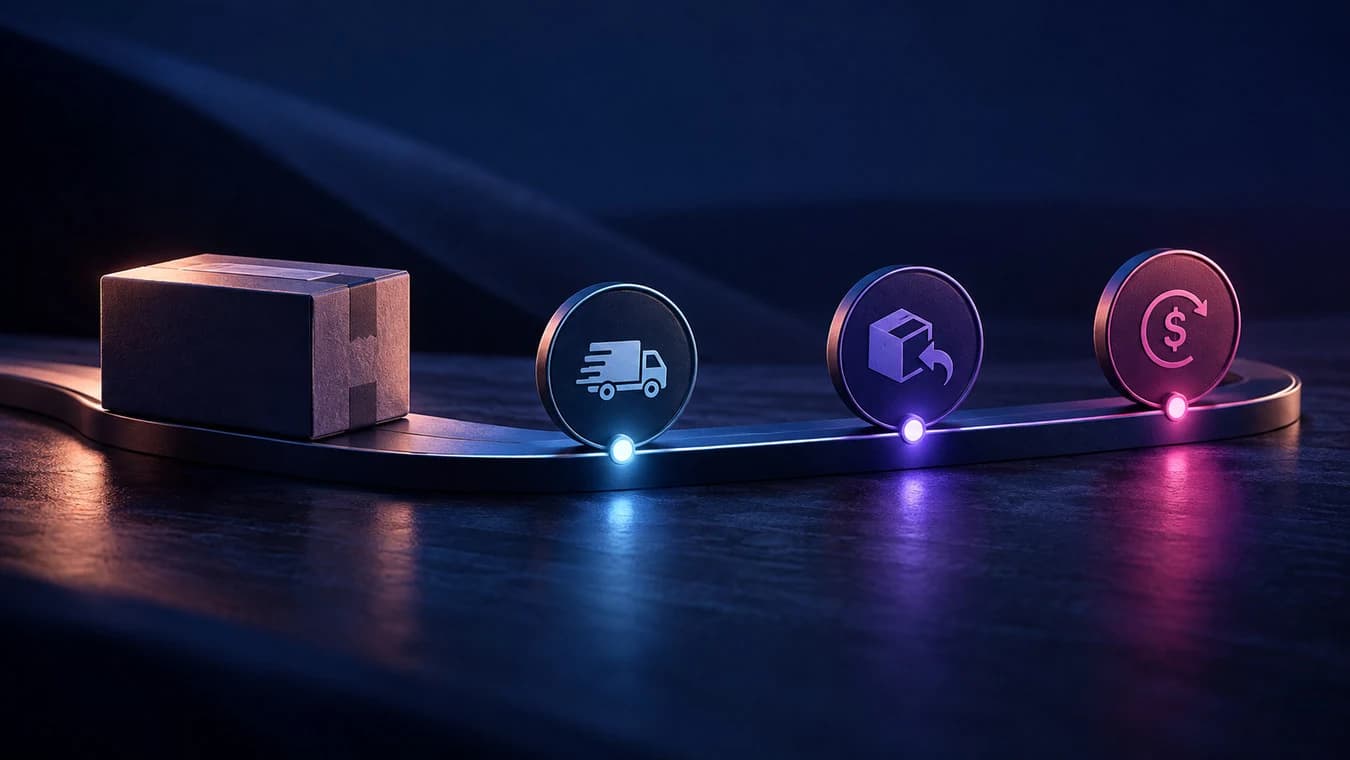
A shared order history connects shipment tracking, returns and refunds, giving customers and support teams the same status and next action.
Explore the solutionSolution design
Customers can see what happens after checkout
The post-purchase service brings shipment, return and refund records into a shared customer view without treating their statuses as interchangeable. Individual items retain their progress and unresolved support cases. Customer messages follow those operational states, while promotional communication respects an outstanding order problem. Support uses the same history to explain what has happened and who owns the next action.
Order, shipment, return and refund information appears in a clear sequence. Customers can complete routine actions themselves, while service teams receive the cases that need a decision and the context to handle them.
- Useful status for split shipments and returns
- Fewer gaps between service and finance
- Messages that account for unresolved problems
- Business context
- An online retailer with delivery partners, a returns operation, customer support and lifecycle marketing.
- Core capability
- Growth Marketing
The customer is following a purchase, not several systems
The retailer may see an order, a carrier consignment, a warehouse receipt and a refund transaction. The customer sees one purchase and wants to know what happens next. When those records disagree or appear in separate places, even an ordinary split shipment can look like a missing item.
The account page brings the relevant states together while retaining their differences. Each shipment shows its own progress. Each returned item shows the next action and who is responsible for it. A delivered parcel does not automatically resolve a complaint, and an approved return does not imply that money has reached the customer's account.
The service starts with the questions support receives
Support contacts are grouped by the question behind them: where the order is, why only part arrived, whether a return is accepted, or when a refund is due. These groups reveal which status is missing and which process is actually stalled. They also prevent an indiscriminate response of sending more emails whenever customers ask for help.
The message review follows the same purchase through transactional and marketing systems. Delivery notices, return instructions, review requests and promotional campaigns share enough context to avoid working against one another. Service messages remain available when marketing is paused. Consent and communication purpose are retained separately, so an operational update does not become permission for another kind of message.
Solution scope
- Customer-facing shipment and order status
- Item-level return and exchange requests
- Support case and refund references
- Event-triggered messages and communication preferences
- Campaign suppression for unresolved service cases
One purchase can have several unfinished parts
The model links an order to its shipments, item returns, exchanges, financial actions and support cases. Stable references allow support to move between them. Status is attached to the correct object: a carrier scan changes a shipment, an inspection changes a return, and payment confirmation changes the refund record.
Events arrive with their source, time and identifier. Repeated events are safe to process again, while out-of-order updates are evaluated against the current state. A historical scan cannot overwrite a newer delivery event simply because it arrives later. Customer-facing explanations translate these facts into plain language without implying more certainty than the underlying record provides.
The customer follows the item all the way back
A return begins with the purchased item and the retailer's approved eligibility rules. The customer supplies the information needed for that decision without re-entering order details already held. Straightforward requests receive the appropriate return route; exceptions reach a person with the original purchase and the rule that needs review.
The return then moves through collection or drop-off, receipt, inspection and the relevant financial action. Each step has a visible owner and status. An exchange links the original item with the replacement shipment, keeping both journeys understandable. Support can explain a delay at inspection without treating it as a carrier problem or promising a refund that finance has not yet initiated.
The operational flow
Receive the operational event
A fulfilment, carrier or finance update is checked against its existing reference.
Explain the current state
The account page shows the affected shipment or item and its next step.
Handle a request
A return follows the approved rules or reaches service with a specific exception.
Complete the handoffs
Warehouse receipt and financial action update the same return history.
Adjust communication
Resolved cases and customer preferences determine which messages resume.
Delivered does not always mean resolved
A customer can report a missing parcel after the carrier marks it delivered. The support case remains open alongside the shipment event rather than overwriting it. Staff see both accounts and follow the retailer's investigation process. Likewise, a missing carrier update generates a service task when action is needed; it does not repeatedly send an unchanged tracking link.
Message rules account for cancelled lines, split shipments and repeated events. Account access is scoped to the correct customer, while staff overrides retain a reason and audit history. Promotional suppression considers active service problems at the relevant customer or order level. It avoids a review invitation arriving during a refund dispute without preventing the operational messages needed to resolve that dispute.
Tracking is completed before more campaigns are added
The first release covers a common shipping journey from fulfilment event to account status, notification and support view. It is tested with a split parcel, a delayed feed and a duplicated event. The service team checks that the page answers the real customer question and that a case reaches the correct queue when self-service ends.
Returns follow with their warehouse and financial handoffs. Existing campaigns are mapped before new triggers are enabled, including any scheduled messages that need cancellation when circumstances change. This prevents the new service from becoming an additional source of emails beside the old ones. Staff can pause an unreliable trigger while the account page continues to show the last verified information.
Each message has an operational reason to exist
Customer service owns case handling, operations owns shipment and return progress, finance owns refund execution, and marketing owns campaign content and preferences. A message template has a named owner, approved wording and a defined trigger. Policy changes are reflected in the return rules and instructions together, instead of leaving customers to reconcile conflicting versions.
Operational monitoring checks the age of source events and the effect of suppression rules. Delivery rates alone cannot reveal that a message was sent at the wrong moment. The review also looks for unresolved replies, repeated contact and customers who cannot find the next action. These signals connect communication quality to the underlying service rather than just the email platform.
Less contact is useful only if the question is answered
Repeat contact about the same order shows where the page or process leaves uncertainty. Return-stage waiting time identifies whether the delay sits with the customer, carrier, warehouse or finance team. Feedback and assisted-service records help distinguish successful self-service from a customer giving up because help is hard to reach.
Repeat purchasing can be reviewed alongside these service records, with comparisons that account for product category, season and promotions. The immediate operating checks are more direct: the status is accurate, the next action is clear, and a customer who needs a person can reach one with the order context intact.
The choices behind the solution
Follow individual items
Keep shipment, return and refund states separate within the purchase.
Split orders and exchanges cannot be explained accurately by one overall status.
Respect an open service problem
Pause relevant promotional messages while preserving service updates.
Campaign timing should reflect the customer's current experience.
Retain event provenance
Store the source and time of each meaningful update.
Support needs to distinguish a late feed from a disputed delivery or a stalled refund.
How the solution is evaluated
These measures define the evaluation criteria for the workflow, its controls and the quality of completed tasks.
Repeat contact about one issue
Measure: Group contacts by order and question, alongside self-service feedback.
Success criteria: Customers receive an answer that remains useful after the first interaction.
Return-stage waiting time
Measure: Review elapsed time and ownership at each return handoff.
Success criteria: Delays lead to a named operational action rather than another generic status message.
Repeat purchasing after service
Measure: Compare relevant customer cohorts while accounting for category and promotional activity.
Success criteria: Service improvements can be assessed separately from changes in acquisition or offers.
The purchase remains active long after checkout. Clear tracking, practical return actions and a visible refund history give that period the same attention as the sale itself. The service also gives marketing a more informed view of when to speak, when to pause and what a customer still needs resolved.
Keep exploring